Tuesday, December 28, 2021

Let’s talk about biting, hitting, pinching, kicking and scratching.

 I have recently learned that there are many childcare centers that terminate for things that are developmentally appropriate.  One of our parents shared with me recently that the center her child was at before coming to us had such a policy for biting and that her 10-month-old was on bite number two, with the third bit meaning they would be terminated. 

Parents are under enough stress without having to worry about their whole life being disrupted because their infant behaves in a developmentally appropriate way.  I know it is upsetting when your child gets hurt while at childcare. Over the years, I have had many parents threaten to leave over their child being bitten.  I feel these policies are a knee jerk reaction to such threats. 

Creating policy that punishes a family for their child behaving like a child, is a missed opportunity. It is a missed opportunity to educate parents on natural child development.  It is a missed opportunity to educate parents on why biting happens and what to do when it happens.  It is a missed opportunity to educate parents to see what is often seen as misbehaving, as what is really is, natural child development.

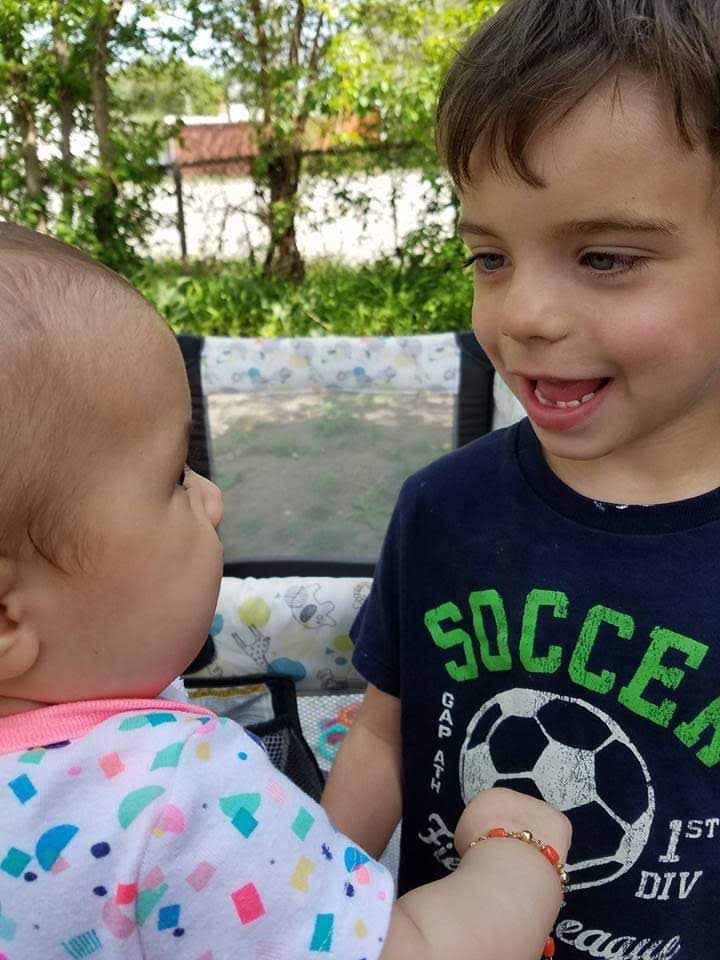
When one toddler hurts another, it is rarely, if ever, an act of aggression.  In this piece I am going to use the word bite to stand in for all the words listed in the title to avoid having to list them all the time. When we have a child who bites our first step of action is to look at what was happening right before the bite.  There are some obvious reasons like fighting over a toy or someone was in their way, and sometimes there seems to be no cause. 

One common reason for biting is frustration. Not necessarily frustration at what just happened but built-up frustration. I’m sure most of us can recall a time when we had a rough day and then snapped at someone for some small infraction.  The same thing happens with toddlers, maybe their morning was rushed, and they didn’t like their breakfast and one friend had taken a toy and now another friend looks like they might take a toy and snap, they bite that friend.  To the observer, it looks like they bit for no reason, but that is not really the case.

Another common reason for biting is a lack of verbal skills.  We all know that in a toddler’s brain, what they had 10 minutes ago is still theirs.  They see another child start to pick up a toy they had earlies and without the words to say “hey, that’s mine” they use the tools they have and bite.  

Curiosity is also another reason for biting.  I have seen toddlers look at another child and simply bit them just to see what happens.  Experimenting is what toddlers do and they don’t know that biting is not an allowed form of experimentation.  Just yesterday, I had a toddler who was sitting near me, bend over and bite the tip of my slipper. This child was not mad at me, this child was not wanting to hurt me, this child simply looked at my slipper and thought “I wonder what it would feel like to bite that?”

None of these children are being bad, they are expressing emotions, communicating and experimenting.  Which is exactly what they are supposed to be doing.


-


Wednesday, October 13, 2021


How do we do it -nap time


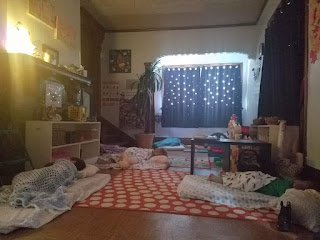
We often hear from families that they are amazed that we are able to get all of the children to sleep at the same time.  So, today I thought I would share what we do to help that happen.  First, I must state that we are not always successful at this, but the majority of the time, these things work.

Routine, I think this is the biggest thing we do to reach this goal. While things do not always happen at the same time, they always happen in the same order.  After lunch the children use the restroom, pick out a book and a stuffy and then sit on their cot looking at their book until all the children are on their cots.  Then the teacher who gets to read (we all love reading at nap and so we take turns) gathers the books and sits down, usually near the youngest two.  The teacher and the children take big deep breaths and then the teacher reads.  Before the last book is read, they all take more deep breaths.  After the last book we turn on the naptime music mix and ocean sounds on a sound machine.   These things always happen in that very order.

Tenacity, sometimes all it takes is being willing to sit or lie next to them and rub their backs or their heads for a good ten/fifteen/twenty minutes.  If someone starts moving their fingers in an attempt to stay awake, we gently rub their arm or hand.  Think about how it feels when you get a scalp massage our when someone gives a gentle massage.

Get tricky, often we have older children who tell us that they are not tired.  We tell them that we understand that they don’t feel tired, but we need to be sure. We tell them that if they really are not tired, they should be able to lie still for one minute with their eyes closed.  We let them get comfy and close their eyes and then we start counting, low and slow.  If they move, we simply start back at one, each time they move or open their eyes, we start over.  Generally, we never make it to 60. Sometimes I will combine counting with a back rub or holding their hand. 

Be flexible, somedays they may need a back rub and for you to count, somedays they might need you to hold their hand and say “shhhhh” (that’s another trick we sometimes use.) The most important thing is to stay calm, without falling asleep yourself.  Just yesterday I had a four-year-old who wanted to snuggle, I focused on taking deep relaxing breaths, she was asleep in less than 10 minutes, and I was very close to sleeping myself.  

So, when you see photos of classrooms of napping children, it is not magic, it is just determined teachers who have a book of tricks up their sleeves to make it happen.  Hopefully you can use some of these tricks at home too. 

Wednesday, July 28, 2021


 The work of childhood!! 

Imagine you go into work in the morning and the boss says you can work freely on whatever you want, you find a project that interests you and you get into it, but before you are finished, you are called to a team meeting. This meeting may be about something that is of interest or importance to you, and it may not be, but you will have to sit and pay attention for the whole meeting because this is important to your boss.  Let's say the meeting lasted 30 minutes and then the boss says you are free to work on any project you want as long as it is one of the prechosen projects.  Some of these projects are ones that can be completed in minutes, and some are ones you can really get into and keep at for hours. It doesn’t matter what task you choose; you must stay at it for the next 20 minutes. When those 20 minutes are up, you must move on to another prearranged task and again, stay at it for 20 minutes which might be too long or might not be long enough to complete the task to your liking. 


Finally, you get a break, but you have to take your break in the area decided by your boss.  As with the inside tasks, the area for your break is limited and there are strict rules to follow.  After you have had 20 minutes to enjoy this break, you are sent to lunch.  Your lunch is chosen for you and consists of highly processed foods and is very carb heavy.  After lunch you get to take a nap, but you have to nap in a room where people are going in and out and talking the whole time.  You finally fall asleep after an hour and just as you fall into a deep sleep, the lights are turned on, you are woken up and told to get up right away. 


You are still groggy from your nap being cut short, but it is time to eat a snack, this snack may or may not be something you like, and you only get one serving either way. After snack, there is another meeting.  At this meeting the boss tells you she wants you to learn about time management.  You might not have a problem with time management but that doesn't matter.  For the next 45 minutes you will be doing activities to teach you about time management.  Some of these might be of interest to you, some might not but you have to do them all. During one of the tasks, you and a co-worker have a disagreement, as you are trying to work it out, the boss 

comes over and takes charge, they tell you and your co-worker how to proceed, neither of you feel satisfied with this outcome but you have no choice but to do what you are told. After you have finished all the time management tasks, you get another break and decide to embark on a project of your own choosing during this break but unfortunately, your break is not long enough for you to finish the project and it will not be saved for you to come back to. 


When you get back to the office, you are told you will need to work in another room with another group of co-workers.  Once in the new space you are assigned a project and must keep that project in the proper spot and cannot collaborate with anyone else unless they were specifically assigned the same project. This is how you spend the rest of your day, unless the boss decides to bring in more people and have you all watch a video that is unrelated to the work you are doing. 


Imagine that you do that same thing day in and day out.  Some of you may enjoy the predictability of these days but I'm sure most would feel frustrated at the lack of control you are given to finish your job to your standards. There is a good chance that you would not look forward to going to work or feel pride in what you are doing.  


Now imagine you go to work and are allowed long periods of time to work on what you want to work on.  If you have to stop for any reason, you get to save your work and come back to it later.  When you take a break, you get to decide how to spend that time and are given many options of activities and the only rule is to not hurt anyone and not break anything.  


After your break, you get a lunch that is made mostly of whole fruits and vegetables along with protein.  After lunch you go to a quiet, dim room to nap. Before you fall asleep there is a relaxing story and then calming music helps to drift off.  When you wake up the room is still dark, there may be a window open, but you can lay and relax until you are ready to get up. 


Once you are ready, you get to have an afternoon snack. The snacks are plentiful, and you get to have as much or as little as you want. 


Then you get to spend the rest of the day working on the project of your choice.  If you and a co-worker have a disagreement, your boss tells you to talk it out and come up with a solution you are both happy with.  You are free to go back and forth from project to project and to work with whoever you want.  


When you leave in the afternoon, there is a good chance you feel fulfilled and happy to have been able to do your job to your standard. 


Now replace the word boss with teacher and you see the difference between your typical early childhood education model and a true play-based model.  Play is the work of children; it is how they learn and how they gain the skills needed to function in life.  When we interrupt play to “teach” we are actually robbing children of the opportunity to learn. 


The Birdsall House way believes that given time and the proper environment, children will learn everything they need to be ready for academic learning. We don’t create lessons, we don’t tell the children what we think they need to learn, we trust them to explore and create their own lessons. 


Friday, July 2, 2021

 The Cost of Care

Hi everyone, I am sorry I have not blogged in a while, but we have been short staffed and I have been filling in. 


High turnover is a constant problem in childcare and this is especially harmful to infants and young children who need to develop strong relationships with their caregivers. 


One of the main reasons for this turnover is low wages and a lack of benefits. 

 As we were advertising for a new team member I got a lot of backlash about the low pay we were offering and how high our tuition rates are. I spent a lot of time crunching numbers to try and raise pay rates and not raise tuition. It can’t be done, at least not in a way that does not lower the quality of care we provide. 


I know that I have already written about advocacy but today I would like to share with you a tool that shows just how expensive it is to provide quality care.  

Please visit https://costofchildcare.org/index.html and enter your state, then enter what you would like to see when it comes to early child care. You will be surprised by how expensive it is to provide that care. 


We are a Group Home Center which is not on the list but it is similar to Family Home Care. I went there and entered Missouri and the only things I clicked on were to lower teacher child ratios and to increase teacher pay. I would need to charge $1471 a month to do that according to their calculations (which is close to what I had come up with.) I do not want to charge my families that much but I do want low ratios and to be able to recruit quality staff members and keep them. It seems like a no win situation and that is just the bare minimum for staff.  

When I clicked to pay staff the same as kindergarten teachers it raised the rates to $1724.  That is more than most people's mortgages. Not many people could afford to pay that.  When I got crazy and clicked to give staff health insurance and retirement plans, the needed monthly tuition went up to $2177 which is an unattainable amount for all but high income families. 


Unfortunately how the high cost of childcare is kept down is by paying minimum wage or just above, offering no benefits and having ridiculously high teacher child ratios. This leads to teacher burnout and high turnover which causes our children to not be able to build those important early trusting relationships. 


Not only do our children deserve better, so do the people caring for them.  Early Childhood Educators and caregivers deserve to make a living wage, they deserve to have the opportunity to plan for their future, they deserve healthcare and they deserve the respect given to all other educators.


Right now our representatives are deciding how to best support families and children.  Please go to  https://www.thinkbabies.org/take-action-american-families-plan/?utm_medium=email&utm_source=email_link&utm_content=baby_monitor_07012021&utm_campaign=Q4_2021_Policy_Center_Resources

And tell them that our children and the people who care for them deserve better. 


Thursday, April 22, 2021

 Learning from our children. 


Over the years I have learned many things from my students.  I have learned dinosaur and animal facts, I have learned a great way to easily describe a tornado and many interesting facts about different religions and cultures. Recently I have learned that not only do the students add to my knowledge of facts, they also provide some amazing life lessons. 

#1 Love yourself

It was a beautiful spring day and the whole crew was outside. I was sitting with a baby on my lap and many of our students around me. 

One of the children said "Ms Kelly, who is your favorite person in the world?" 

I said that was a hard question and I was trying to come up with an answer. Some of the children were helping me try to figure out the right answer. 

We decided that it couldn't be one of them because I love them all.  It couldn't be one of my own children because I have three and love them all equally.  One of the children said it should be my granddaughter because I only have one grandchild.  

I was ready to settle on that answer when a very wise 7 year old said "Ms Kelly the answer should be you, it is very important to love yourself."  I could not argue with that answer and we then got into a great conversation about why self love is important. 

#2 Check in on your friends

Everyone was getting ready to go outside one morning, one of the children stopped to use the bathroom on the way out.  Another child got their coat on and was heading to the back door when she stopped at the bathroom door. I was prepared for a typical 3 year old interaction, perhaps she was going to ask when the other child was going to be finished or tell them that she needed in. 

I was not prepared for what she actually said.  

She opened the door just a crack and said "Are you doing ok?" to which the other child said "Yes, I am, thank you for asking." 

I guess you could say I learned two lessons from this encounter, lesson one was the importance of checking in with our friends to make sure they are okay and lesson two was to stop underestimating how kind our students are. 


Tuesday, March 9, 2021


Advocacy 

This is Missouri State childcare advocacy week and I thought I would share with you why I think advocacy is important.

In the last week I have added five children to our waitlist.  We currently have a waitlist that is almost double our legal occupancy.  While part of that is because we have an amazing program that provides loving care and encourages social emotional growth. We also provide a stimulating environment that encourages creativity, problem solving, and higher order thinking, along with creating a community of support for our families and staff. 

Unfortunately, I don’t think our greatness is the whole reason we have such a long waiting list. I think it also has to do with the lack of other amazing places in our area.    

Prier to Covid we were already in a childcare desert, for every 40 children who needed PreK care, there was ONE spot available.  In the last year, almost 40% of small centers in Missouri have closed their doors permanently.

I often hear from families who put their child on numerous waitlists, hoping to get in somewhere soon.

I have had parents tell me that the center or home they take their child to was not their first or even second choice, but they needed childcare and that place had a spot.  

This is not how it should be!

As a director I have struggled in the past to find quality staff and options for substitutes are nonexistent at times.  Our centers need to be well staffed and there needs to be consistency in care. Consistency allows for strong attachments to form and those attachments allow a child to feel safe.  Many centers are struggling to find quality staff and turnover in early childhood is very high, making it hard for children and families to form attachments with caregivers.

This is not how it should be!

We all know that the first three years are when most brain development happens and that the years 3 to 5 can either prepare a child for school and life, or not. Parents should have numerous high-quality centers/homes with open spots to choose from.  Some parents may want early academics (despite the evidence against it) and they should have many such places to choose from.  Other families may want a play-based center where the children are outside much of the day, like Birdsall House. There should be many high-quality play-based centers for families to choose from.

The only way that is going to happen is to invest in early childhood.

The only way investment will happen is through advocacy.  We need to advocate for investment in the quality centers we already have so that they can grow and serve more children.

Did you know that many centers require a teacher to have a degree and yet the average wage for childcare in Missouri is $11.29 an hour.  Many collages are finding fewer and fewer students who want to study early childhood education due to the low wages.

The only way to change this is to invest in early childhood.

The only way investment will happen is through advocacy. We need to advocate for investment in early childhood so educators can earn a livable wage without raising the burden on families for the cost.

Our families deserve to choose who they want to trust to help raise their children. Our caregivers deserve to not have to stress about how they are going to feed their own children.

This is why I think advocacy is important.  Advocacy can be as easy as signing a petition or filling in a form to send an email.  Please consider adding your voice to the many others advocating for our children.

If you would like to be an advocate for early childhood but do not know where to start, check out http://kidswinmissouri.org/ for more information about advocacy campaigns you can add your voice to.

Thank you for supporting and advocating for children and the people who care for them.


Friday, January 29, 2021

 Let them cry

It might surprise you to know that I do not mind walking into the center and hearing children cry, in fact I like it. 

If the children never cried, I would worry. 

I would worry that the children were not being allowed to experience conflict.

I would worry that the children were being placated to keep them happy.

I would worry that the children were getting the message that it was not okay to cry.

I remember once when I worked at a traditional center in the infant/toddler room and my director walked in and asked why one of the children was crying.  I replied that she was sad, and the director told me to make her stop because they were giving a tour and it did not look good.

As my past employers will tell you, I did not always follow orders.  This child was sad, she wanted something someone else had and despite us offering other toys, she was still sad and deserved to be allowed to express that sadness.  Fortunately, she had moved on by the time the tour came by, but I had been prepared to defend her right to cry if needed.

Not only do infants deserve and need to cry and express their emotions, so do toddlers and preschoolers and even adults. 

That baby that needed to cry became a toddler and preschooler who sometimes needed to cry.  Why would she need to cry you might ask, well, there are many reasons.

None of her friends wanted to play what she wanted to play.

One of her friends played with someone else.

Someone else was playing with the toy she wanted.

And so on, there are many reasons for a child to be sad, frustrated, or angry and they deserve to be able to express those emotion

As adults most of us don’t like it when we are upset, and someone tells us to “Calm Down” or says, “It’s Ok, don’t cry”. I know for me, when someone says those things, I feel like they are not really understanding or listening to me. Instead, I like it when my friend says, “I know that you are feeling sad and it you need to cry, then cry”. 

When we go to great effort to stop a child from crying by distraction or bribery, aren't we really telling them that it's not okay for them to be crying? That how they are feeling is wrong and they need to stop expressing it?  That the only emotion we are comfortable with is happiness?  What do they learn from that? 

It seems like we expect our children to control their emotions better than adults do, but when we do not allow them to express emotions, how are they supposed to learn to control them.

The crying child I mentioned earlier is now an amazing 8-year-old who is wise and empathetic, yes, she still cries but don’t we all. And that’s okay.


Tuesday, December 29, 2020

 The Job of a Toddler part three

Getting what they want

Toddlers are experts at trying to get what they want.  

While I have never agreed with the term "terrible two's", I fully agree with the term "tenacious three's" but have also met many tenacious two's and even one's. 

One of the most important lessons learned during the toddler years is "how to get what I want". Toddlers will try many tactics to get what they want and the lessons they learn all depend on how parents and caregivers respond to the tactics used.  

I just spent time with a very tired three year old who didn't want to sleep. I know this child well and know that a skipped nap could end in a very unpleasant evening for her family. She employed all the typical moves, she got up and used the bathroom twice, she argued that she wasn't tired, that she was hungry and thirsty, that her clothes hurt, and on and on.  I continued to assure her that she would be ok if she waited for after nap snack because she had JUST eaten a big lunch, that her clothes were bothering her because she was tired and on and on. While it can be very frustrating watching her fight sleep, I know that she needs a nap and she needs me to allow her to test and not give in.  

Keeping a calm demeanor while dealing with a testing toddler is not easy but is very important.  If possible, tag team with one parent or caregiver switching with another when needed. This sends the message that everyone is on the same page and models cooperative behavior. 

Don't ever hesitate to say "I'm feeling frustrated right now and need to take a break, I'll be back in a few minutes to help you some more". Then go into another room and do whatever works for you to remain or regain your calm.  By doing so you let them know that you are not going to give up just because you are frustrated and also show that it is ok to be frustrated and to take a minute when needed. 

Many toddlers will at some point try the tantrum method of getting what they want.  I know that there is a lot of conflicting advice out there about tantrums and I always say to go with what feels right for you and works for your family. My advice is to acknowledge how they are feeling, restate why they can't get what they want and go on with your day. Remember, they can't always get what they want and they have the right to be upset about that.  

Here we see my granddaughter showing my entire extended family at a Christmas party how upset she was that she couldn't have what she wanted. 


And now her reaction when she realized a room full of people were going to let her express her feelings, but were not going to give her what she wanted. 

I recommend only paying attention to a tantrum if they are throwing things or doing something else that could hurt someone.  As with all toddler behavior, acknowledge how they feel with statements like " I know you really wanted a blue cup but all the blue cups are being used", or whatever is fueling the tantrum and then let them be. They will soon learn that tantrums don't work, it may take a few tantrums before they are sure that you won't give in, but if you are consistent, they will learn that this is not an effective way to get what they want.   

The most important thing to keep in mind is that it's ok for your child to have strong negative emotions, it is not your job to keep them happy all the time.  Despite what they may say, what they need most from you is to know that you are in charge, you can and will make the big decisions and you will love them no matter how hard they push and test.  
Always remember that the safer, more loved they feel, the harder they will test you.  So the next time your toddler melts down in public and you feel everyone's eyes on you, remember that what they think is not important, your child seeing you be strong in the face of their emotions is. 


Tuesday, December 22, 2020

The Job of a Toddler part two


In my last blog I wrote about toddlers and how they test in their interactions with other children.  Today I will talk briefly about how they may test you at home.

Hitting

Every toddler I know at one point tested their parents by hitting them.  It can be quite a shock the first time your sweet baby hits you and you do not know how to react.  My advice is to always react naturally, when someone hits you, it hurts.  Tell your toddler that it hurts you, make a sad face, say “ouch” whatever feels natural to you and gets the point across that it hurts (even if it does not really hurt.) If you are holding them and they repeatedly hit you, put them down, tell them that you will not allow them to hurt you and if they are going to hit, you will not hold them.

If they are hitting siblings, tell them that you will not allow them to hurt their brother/sister and if they want to play with them, they need to not hit, otherwise they will have to play by themselves.  This is a natural consequence, and the important thing is to ALWAYS remain calm and to say this in a calm, matter of fact way.  With some children you will only need to move them a few feet away, with other children you might need to use a play pen or a room with a gate.  Try not to make going into the play pen or other room seem like punishment.   Instead, it is just what needs to be done to keep others safe and always allow them to rejoin the group as soon as they are calm and ready.  Do not put them in for any set amount of time. 

Setting a timer for a set amount of time for them to “think” is punishment, allowing them to tell you when they are ready is discipline.  One is intended to punish, the other to teach.

Climbing

Imagine the joy of learning that you can climb onto all sorts of surfaces you had thought were out of our reach.

 It is like if you as an adult woke up one morning with the power to jump really high, I’m pretty sure most of you would test that power out and visit the tops of nearby buildings.

There is a good chance your toddler will try to climb on shelves, dressers, tables, and the list goes on.  This is an instance in which I have found that how we word things really makes a difference.  Instead of saying “NO” or “don’t climb” say “that’s to high”, “that’s not safe” or “keep your feet on the floor”, or stool or whatever they are allowed to climb/stand on.  If you walk into a room and find them on a table, show concern and say, “Please get down, that is not safe” and then talk about the surfaces they might hit if they fell off the table.  If you have a stool that you let them stand on to help in the kitchen, but they keep using it to climb onto the counter, tell them that it is not safe and if they continue, you will have to take it out of the room, and they will not be able to help you.  The important thing is to do it if you say it and while your toddler may cry for a day while they watch you cook without them, the next day they will probably not climb back up and if they do, take the stool away for another day.  

 As with hitting, biting, throwing and all the other many experiments your toddler is going to engage in, consistency in your reaction will make a difference and will allow them to learn what is acceptable and what is not. 

If you establish the rules, explain the consequences of not stopping the behavior, consistently enforce those consequences, acknowledge how everyone in the situation feels and try to keep calm, you will get through this.

Some examples of how to phrase things are

·         I know its frustrating that you can’t climb on the counter but It’s not safe and I worry you will get hurt.

·         I won’t allow you to hurt me, I know you are frustrated but hitting is not ok.

Toddlerhood is full of challenges, but it is also full of joy, one day you will look back on these days and smile.

Just remember the big 3 C’s

Calm, consistent and caring.  


Friday, December 18, 2020


The Job of a Toddler


I remember when I had my first toddler class back in the 1990’s.  One girl entered my class as a sweet agreeable toddler who had just turned one and was just starting to walk. In less than a month her mom was asking me “what happened to my sweet baby?”

Between the ages of one and four, children experience many changes, they learn to walk and talk and most importantly, they learn that they have power.

They have the power to express how they feel, they have the power to get what they want, they have so much power that they did not know they had before. 

Imagine you woke up one morning and discovered that you had a superpower, you would spend some time learning about your power, you would want to learn when and how to use it, how to control it, and just how far you could push it. In your attempts to understand and control your power, you might hurt other people; you might knock someone over as you fly by fast or startle someone as you run past.  You are not meaning to hurt them; you are not being mean; you are just not experienced enough with your powers to safely use them.  That is basically what a toddler is doing in those amazing and challenging toddler years.

This happens at different times for each child, just as all stages of development do.  I have known one-year olds who start testing boundaries and other children who do not start this until they are three.  No matter when they start, it is an important part of their development.  

They need to test the boundaries; they need to find out what happens when they take a toy from a friend or even when they knock another child down.  This is how they learn to use and control the power they have.  Some children push and test these boundaries for a short period and others will keep at it for months. 

This is one of the reasons why strong relationships with care givers is important.  Children need to know that they can push and push and test and test and still be loved and valued by their caregivers. Often the safer, more secure they feel, the harder they will test and push the boundaries. 

The important thing for parents and caregivers to remember during these times is that your child is not turning into a spoiled little sociopath and this behavior will not last forever.  It is also important to be consistent in how you respond to this behavior. 

I have found that the best strategy is to acknowledge how everyone in any given situation is feeling.  I recently had a two-year-old take a toy from a one-year-old.  The one-year-old cried for a few seconds and then went on to play with something else.  After watching to make sure the situation did not develop into a physical fight for the toy, I talked to the older child about what happened and about how the other child probably felt.  I did not force him to give the toy back, the other child had already moved on, I did not tell him that it was mean to take the toy, because he was not being mean, he was being two.  I helped him to understand how his action made the other child feel.  Will he take another toy, probably, will we have the same conversation twenty more time, probably? But if we consistently help him to understand the consequences of his actions, he will learn. 

There are many ways in which young children will test the boundaries, as long as you stay calm, stay consistent and talk to them, you will make it through and more than likely your sweet baby will come back as a sweet child. 


Tuesday, November 10, 2020

Mixed ages, it's only natural

One of the most unique things about Birdsall House is our mixed age group setting.  In a home, children are not usually born in litters and the younger ones learn from the older ones. Yet for some reason the traditional early childhood setting separates children by age. When you do find a program that has mixed ages groups they separate the infants and toddlers from the older children, in fact in Missouri if you have more than 20 children in your care, you have to have a floor to ceiling wall between these groups. When I found this out I was very disappointed and decided the benefits of mixed ages was so great that we will keep all our centers at 20 children or less.   

Here are the reasons I feel so strongly about letting our infants and toddlers interact with our 3,4, 5 year old's and more. 

Children learn by observing and mimicking, if children are only with children their age, they will not be inspired as much as if they are with older children. 

Here we see a two year old being inspired to challenge himself by watching his 7 year old brother. 


Children develop a sense of family with their fellow students and the older children get the opportunity to mentor and take a leadership role. 


Children do not feel pressure to achieve a skill or reach a milestone.  Everyone is at a different place in their development. The children accept each other for where they are and encourage each other when they try something new.  

There is no better way to interest a child in learning than for them to see their bigger friends doing it. 


Not only do the children learn from and teach each other, they also stay with the same group of teachers from infancy to when they leave for elementary school. 

I can't imagine going back to teaching in a single aged classroom, I see no benefit to it and would miss seeing magical interactions like this. 


Monday, October 12, 2020

Not STEM, not STEAM but STREAM!!

 You hear a lot of talk about STEM education and about STEAM, I'm personally glad they added the A for arts because art is a great learning tool but neither of those are appropriate for early childhood for a couple of reasons. 

First, children are natural scientist, engineer's, artist and inventors, all we need to do is give them the freedom to do so. So STEAM in early childhood should be naturally happening. 

Second, what is needed most in early childhood is relationships.  

Here at Birdsall House we let the STEAM happen naturally and we add the R to make STREAM through consistency in staffing and fostering respectful relationships from infancy on.  

By modeling caring respectful interactions we teach the children how to have caring respectful interactions, themselves.

I remember watching one of our students who was three at the time playing with a one year old.  She was using a blanket to cover and uncover the one year old and each time she would stop and say "did you like that? Do you want me to do that again?" which was met with a giggle indicating "yes". 


Not only are the relationships between the children important but also the relationship between child and staff really matter.  When children feel safe with and loved by their caregiver, they feel free to experiment and explore, which leads to learning. 

There is one negative to building these strong relationship though, the same feelings of safety and love that allow an infants to explore, also allow a toddler to push push push the limits.  But we are ok with that, we know it's their way of learning what is expectable and we feel honored that they trust us enough for them to push the limits, knowing they will always be kept safe and loved. 


Monday, October 5, 2020

Teaching with a mask on

 When we decided to reopen in May we put in place recommended Covid precautions, which included having all staff members wear masks.  

Most of our students have been with us for awhile and we knew they would be alright with us wearing masks but we had infants scheduled to start and we had some concerns about that. I spoke with other directors and with teachers and everyone was expressing the same concern. 

We worried that it would be difficult for them to get to know us and trust us with half our faces covered.  We worried that they would have a hard time with language development because they could not see our mouths to mimic our movements. I love having babbling conversations with infants and was worried that the mask might hinder that. Basically we worried about a lot of things but we knew that we had no choice, we needed to keep everyone safe, that was our first priority, so we needed to wear masks. 

There was no need for us to worry.  As often happens, we were not giving infants/toddlers enough credit. 

They have had no trouble getting to know us and telling us apart.  They can tell our faces by our eyes and eyebrow shapes.  They can tell us apart by our voices.  When a new teacher comes into the room and greats the little ones, their faces light up. 

They have not had trouble with language development. For one thing, they see their parents faces at home and can see their mouths move.  For another, they are adapting and focusing more on the  different sounds they hear than on the movement of our mouths.  I can still have babble conversations with the infants and while they can't see my mouth as I make new sounds, they still try to mimic the sounds I make and laugh when I make the same sound they are making.

In the four months that we have been open, three infants have started in our program and there has not been any difference in how they have adjusted than infants in the past. 

We also have toddlers who are starting to mimic words and the masks don't seem to be limiting their understanding at all. 

So, while wearing masks may not be ideal, it is not turning out to be the problem many of us thought it would.  

When you have staff who love their job and the children they care for, masks can't hide that and the children know it. 


Tuesday, September 29, 2020

Be kind to yourself and remember this is not how learning should be

 This blog is for anyone attempting to help a child with virtual learning. 

 As part of Birdsall House's mission is to support families and to do what we can to help them be successful.  As part of that mission we offered space and a teacher (me) for our graduates to do virtual learning.

So far it is going well and I am really enjoying seeing just how much they love learning.  It is also exciting to see that even though we didn't teach them anything, they know a lot. 

Today I was given a great example why virtual learning is not really appropriate for kindergarteners. Now I know that it was necessary for schools to start virtually and I am in favor of anything that protects us all from exposer to Covid 19.  That being said, it is still not developmentally appropriate for kindergarten and that can take a tole on both the child and the person helping them.  

Here's what happened this morning. 

The kindergartner I am helping has what is called "WIN" time for math and reading.  What this is is a list of activities or links to online games to support their virtual learning.  

This morning they chose a game that had the children sorting coins. There were pennies, nickels, dimes and quarters on the screen.  The child simply needed to touch on a penny and put it in the box labeled $.01 and do the same for the nickels, dimes and pennies. I thought this would be easy for him to do, I was wrong. He had a hard time telling the pennies, nickels and dimes apart, I got frustrated, he got frustrated. We decided to take a break and have him do something else.  During that break I thought about the game and why he had found it so hard.  

I had to make the mental switch from someone assisting a grade school child to my normal early childhood authentic learning mode.  I realized how difficult it would be to learn about coins from a screen. 

I then got out my coin saving jug and poured out a pile of coins and asked him to sort them.  He picked the coins up, matched the size and also took notice of the designs. He noticed that the quarters had different backs but were easy to recognize due to their size. He explored the coins, noticing all the similarities and all the differences. After about 10 minuets said "Ms Kelly, I'm ready to play the game again and I won't need your help now."  We got the game going again and sure enough, he played for about 15 minutes and were very proud of how well they did by themselves.

I am a professional educator and I find myself struggling with helping on line learning, so please, if you are struggling with the same thing, be kind to yourself.  Also think about ways to bring the learning to life if you come across an issue like I did today.  


Friday, September 25, 2020

What Parents deserve

 I have been going through old emails and found one that reminded me of one of the reasons I started Birdsall House.  

At the time I was the lead teacher in an infant classroom.  When parents enrolled their child in my class they were told that the child would stay with me for the first three years, that I would move with the child to the next classroom.  This didn't happen.  

The parents were given no real say in this.  There was one family that I had advocated for quite often about things like what they could send for their child to eat and other small issues.  After their child was moved from my class I continued to help the family navigate things though I had less power over what happened in other classrooms.  

One of the emails I found was from this mother and there was one line that really spoke to one of the biggest issues I have seen in centers where I have worked.  That line was "I feel like we have no real say in what happens with our child."   

No parent should feel this way.  No parent or guardian should have to leave their child in a place where they don't feel they are listened to or where they feel they have no choice but to let things happen that they are not happy with. 

One way we addressed this issue is by having no classroom.  All of our children play together and interact with all of our staff.  We have staff that may spend more time with the infants but they also play with the older children.  Children are never moved to another classroom where they don't have access to a teacher they have grown close to. 

We understand that in the first three years of life the most important thing for healthy development is trusting relationships. If a child does not trust that the caregiver they are with loves them and will keep them safe, the child will be less likely to explore and experiment with their environment.  Having consistent care givers in the first three years allows a child to feel safe enough to take risks and try new things.  S well as allowing for strong relationships between parents and caregivers, allowing for parents to have say in what their child does and to feel confident that their child will be well cared for. 

Every parent deserves to feel that way!!!   


Monday, September 21, 2020

What is The Birdsall House Way?


 Hi and welcome to The Birdsall House Way blog.  My name is Kelly Raines AKA Ms Kelly and I founded Birdsall House in 2015 along with my friend Nikolas Huffman.  I had worked in early childhood education for 25 years and in numerous centers during that time. 

Over the last 5 years Birdsall House has proven to be everything I hoped it would be and I'd like to share a bit about that with you. Our focus is on science and the arts, with those as starting points the learning grows. Here is an example. 

Albert Einstein is credited as having said:

If you want your children to be intelligent, read them fairy tales. If you want them to be very intelligent, read them more fairy tales.

We agree!

At Birdsall House we have no set plans on where the days learning will go.  We observe and look for opportunities to expand on what the children are doing. Here is a great example using a modern fairy tale.

One day one of the children asked one of our teachers to tell a story.  The teacher decided to tell a very animated version of The Lord of The Rings, complete with action and voices, the children were enthralled.

The children went home that night talking about Gandalf, Frodo, and Bilbo and their parents were surprised and thrilled. 

The next day one of our students brought in a LOTR sketch book so they could see the characters.

The children continued to ask for the story to be told and to discuss the story and use it as inspiration for pretend play. 

The next week one of the children brought in a map of Middle Earth.  Everyone gathered around to look at where the different places in the story were.  They explored the map key and discussed the hills, valleys and other aspects of the map.


Let’s talk about biting, hitting, pinching, kicking and scratching.

 I have recently learned that there are many childcare centers that terminate for things that are developmentally appropriate.  One of our p...